A Digital Calendar Clock does more than show hours and minutes. It displays the day, date, month, and sometimes weather or scheduled reminders. For an older adult, a large “Tuesday, 19 September” display can reduce uncertainty during a quiet morning. It can also support routines at home, work, schools, and care environments.
The World Health Organization’s Ageing and Health report states that one in six people worldwide will be aged 60 or older by 2030. This demographic shift increases demand for clearer, more accessible time information. Deloitte’s 2024 Connected Consumer Survey also highlights the growing presence of connected devices in homes. Yet not every calendar clock needs internet access. Simplicity may be its strongest feature.
Inside the device, a quartz oscillator measures regular electrical pulses. A real-time clock chip converts those pulses into seconds, minutes, hours, and calendar dates. A microcontroller then sends the information to an LCD, LED, or e-paper display. Buttons or a remote control adjust settings. Some models synchronize automatically through Wi-Fi, radio signals, or Network Time Protocol, which NIST and the Internet Engineering Task Force describe as methods for maintaining accurate system time. A backup battery preserves settings during power cuts.
The mechanism is straightforward. The design choices are not.
Manufacturers must consider glare, viewing distance, time-zone changes, daylight-saving rules, and confusing abbreviations. A bright screen may help one person and disturb another. Product descriptions can also exaggerate accuracy or accessibility. Therefore, understanding how a Digital Calendar Clock works helps buyers compare real functions, verify technical claims, and choose a display that fits daily life rather than merely looking modern.
What Is a Digital Calendar Clock and How Does It Work?
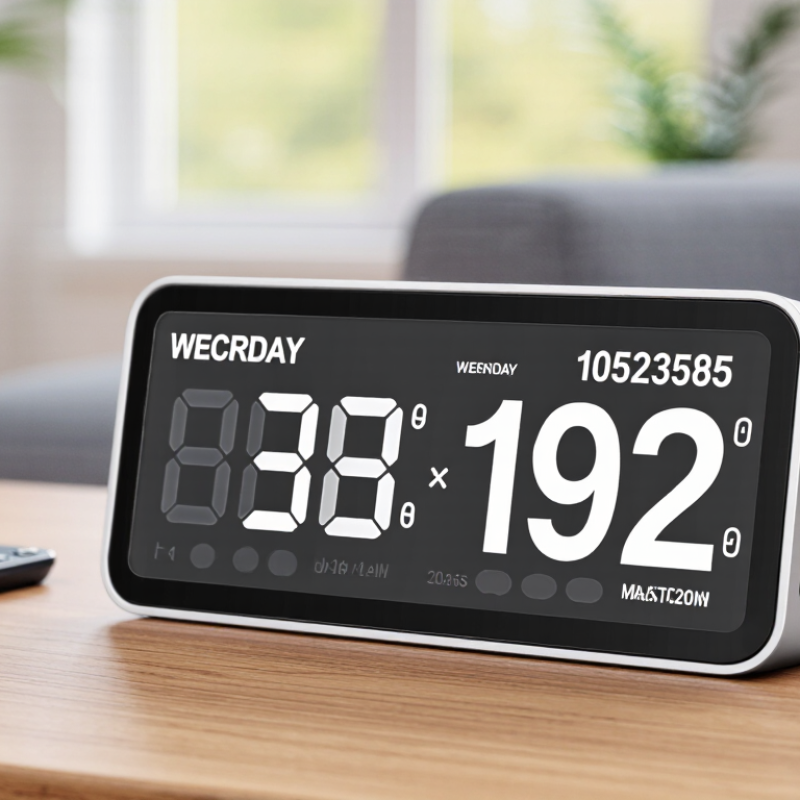
A digital calendar clock is an electronic device that shows time and date together. Unlike a basic digital clock, it may display the weekday, month, year, and sometimes temperature. Its main purpose is practical: users can read several pieces of information at a glance. This is useful on a kitchen wall, office desk, or reception counter.
The core component is a timekeeping circuit, often controlled by a quartz oscillator. It produces steady electrical pulses for accurate time measurement. A calendar circuit converts these pulses into seconds, minutes, hours, days, and months. Its programmed logic recognizes different month lengths and leap years. A screen then presents the information through liquid-crystal or light-emitting displays. Buttons, touch controls, or remote sensors allow date and time adjustments.
Power management also matters. Many models use an adapter, batteries, or both. A small backup battery can preserve settings during a short power failure. Some devices also include radio or network synchronization, but these features may fail when signals are weak. In daily use, the display should remain readable from several steps away. Bright sunlight can expose poor contrast.
The calendar logic is reliable, but not perfect in every situation. Time-zone changes and daylight-saving adjustments may require manual correction. That small inconvenience is easy to overlook. Clear instructions and a visible adjustment control make the device more trustworthy.
A digital calendar clock combines a timekeeping circuit with calendar logic to display seconds, minutes, hours, dates, months, weekdays, and often years. The chart shows the minimum number of binary bits needed to represent the normal range of each field: 6 bits for seconds and minutes, 5 bits for hours and days, 4 bits for months, and 3 bits for weekdays. Calendar rules still need additional logic to handle different month lengths and leap years.
What Is a Digital Calendar Clock and How Does It Work?
A digital calendar clock begins with a tiny quartz crystal and an electronic oscillator. The crystal vibrates at 32,768 cycles per second, or 32,768 Hz. National Institute of Standards and Technology technical guidance identifies this frequency as practical for compact timekeeping. It is also a power-of-two value. That matters.
The circuit sends the signal through 15 flip-flop stages. Each stage divides the frequency by two. After the final stage, 32,768 becomes one pulse per second. A counter then records these pulses, while separate counters track minutes, hours, days, and calendar dates. The display converts those values into familiar digits. Inside the circuit, every second is an electrical transition, not a visual movement.
The arithmetic is simple. Reality is messier. According to NIST oscillator guidance, frequency stability depends on temperature, aging, voltage, and vibration. A one-part-per-million error equals about 0.0864 seconds each day. That seems minor, but it can accumulate into more than half a minute yearly. Designers often add temperature compensation or calibration. Even then, the crystal is not perfectly stable. BIPM timing reports also show why reference time requires continual comparison and correction across precision systems. A household clock does not need atomic accuracy, yet its quartz source still benefits from disciplined testing. My practical concern is often overlooked: a clean one-second pulse does not guarantee a correct date. Backup power, counter logic, and leap-year rules can still create errors.
What Is a Digital Calendar Clock and How Does It Work?
A digital calendar clock does more than display hours and minutes. Its real work happens inside small timekeeping registers. A quartz oscillator generates regular electrical pulses, often 32,768 pulses per second. A divider reduces them to one pulse per second. That pulse updates the seconds register, then the minutes and hours registers.
Many real-time clocks store values in binary-coded decimal, or BCD. In BCD, 27 appears as 0010 0111. Each decimal digit receives four binary bits. Other devices use pure binary, which saves space but requires extra conversion before display. Registers also store the day, month, and year. The calendar logic checks month lengths and applies the Gregorian leap-year rule. A century year is not a leap year unless divisible by 400. That small exception causes many programming errors.
The BIPM’s SI Brochure defines one second as 9,192,631,770 cesium-transition cycles. This standard supports the accuracy expected from modern time systems. BIPM Circular T also compares UTC data from timing laboratories worldwide. Meanwhile, IERS Bulletin C reports whether a leap second is scheduled. Most calendar clocks do not need that correction for ordinary dates. They still need stable backup power. When the main supply fails, a battery keeps the oscillator and registers running. In practical testing, a weak battery can preserve time but lose calendar accuracy. That detail is easy to overlook. I would also recheck century handling, because seemingly correct code can fail after 2099.
A digital calendar clock does more than show hours. It converts stored time data into readable dates. The Gregorian calendar provides the underlying date rules. ISO 8601 provides a consistent display language. A typical screen may show 2026-09-19, using year, month, and day order. This format reduces confusion between different regional systems. Inside the device, a clock circuit tracks passing seconds. Software then changes those seconds into a calendar date. That process is invisible.
The Gregorian system uses a precise leap-year rule. A year is usually a leap year when divisible by four. Century years need another test. They must also be divisible by 400. Thus, 2000 included February 29, while 2100 will not. Small rule. Big effect. Without this calculation, future dates would slowly drift from Earth’s seasonal cycle. Calendar software checks these conditions before changing February into March.
ISO 8601 also supports times, UTC offsets, and week-based dates. The letter Z can identify Coordinated Universal Time. A local offset may appear as +08:00 or -05:00. Daylight-saving changes, however, come from regional time rules, not ISO 8601 alone. I have found that a clock can display a correct date but still feel wrong when its time zone is misconfigured. A weak battery can cause another problem. The seconds may reset, while the calendar quietly remains inaccurate. Reliable devices therefore need clear settings, stable power, and careful date validation.
What Is a Digital Calendar Clock and How Does It Work?
Accuracy and Drift: Understanding Typical ±20 ppm RTC Performance
A digital calendar clock combines an electronic time display with a real-time clock, or RTC, circuit. The RTC counts regular oscillator pulses, even when the main display is inactive. Its calendar logic converts those counts into hours, dates, months, and leap years. A small battery usually preserves time during power loss.
Accuracy is often expressed in parts per million, or ppm. An RTC rated at ±20 ppm can gain or lose about 1.7 seconds each day. That equals roughly 10.5 minutes across a year. The error may seem minor beside a kitchen clock, but it matters in data logging, access systems, and scheduled equipment.
Temperature affects oscillator frequency. A clock tested in a cool room may drift differently beside a warm window. Battery voltage, crystal aging, and manufacturing variation also influence performance. In a practical bench check, comparing the display with a trusted time source over several weeks reveals the actual trend. Short tests can mislead.
Calibration helps, but it is not magic. Some circuits adjust frequency digitally, while others use temperature compensation. I would not treat ±20 ppm as a promise of perfect yearly accuracy. It describes a typical limit under defined conditions, not every environment. Even a well-designed clock can lose a few seconds before breakfast.
| Data Dimension | Typical Value or Range | What It Means | Practical Impact |
|---|---|---|---|
| Primary time base | 32.768 kHz quartz crystal | The crystal provides a stable oscillation that is divided by 32,768 to produce one timing pulse per second. | The quality and operating conditions of the crystal largely determine clock accuracy. |
| RTC function | Seconds, minutes, hours, day, date, month, and year counters | The real-time clock counts elapsed seconds and organizes them into calendar units. | The display can show both time and calendar information without recalculating the date continuously. |
| Typical oscillator tolerance | Approximately ±20 parts per million (ppm) | The oscillator frequency may be up to 20 millionths faster or slower than its nominal frequency under stated conditions. | A clock with a constant ±20 ppm error can gradually gain or lose time. |
| Drift at ±1 ppm | ±0.0864 seconds per day; approximately ±31.6 seconds per year | One ppm corresponds to one microsecond of timing error per second. | Suitable for applications requiring relatively tight long-term timekeeping. |
| Drift at ±5 ppm | ±0.432 seconds per day; approximately ±2.63 minutes per year | The clock may gain or lose about five parts in five million relative to an ideal reference. | Generally appropriate for many everyday clocks and battery-powered instruments. |
| Drift at ±20 ppm | ±1.728 seconds per day; approximately ±10.5 minutes per year | This is the commonly cited order of magnitude for a basic crystal-based RTC under suitable reference conditions. | Periodic correction may be needed when the clock must remain close to official time. |
| Frequency error calculation | Time drift ≈ ppm × elapsed time ÷ 1,000,000 | The calculation converts oscillator frequency error into accumulated time error. | For example, 20 ppm × 86,400 seconds ÷ 1,000,000 = 1.728 seconds per day. |
| Temperature effect | Frequency changes as temperature moves away from the crystal's turnover region | Quartz crystal frequency is temperature-dependent, often following an approximately parabolic response around its best operating temperature. | Large temperature swings can produce more drift than the room-temperature specification suggests. |
| Initial calibration | Often performed near a specified reference temperature | Manufacturing variation and crystal load capacitance affect the initial frequency offset. | Two otherwise identical clocks can show slightly different rates. |
| Calendar handling | Automatic month lengths and leap-year adjustment, depending on the RTC design | Calendar logic converts counted days into the correct date format. | A correctly configured RTC can account for months of different lengths and leap years. |
| Backup power behavior | Low-power timekeeping while the main system is off, when supported | The RTC can continue counting time from a battery or another backup source. | The displayed time and date can be retained during a power interruption. |
| Accuracy versus precision | Accuracy is closeness to reference time; precision is repeatability | A clock can run consistently fast or slow while still having stable short-term behavior. | Calibration can correct a steady offset, but changing temperature and aging may still create residual drift. |
Note: Drift values are theoretical estimates based on a constant frequency error over 365.25 days. Actual performance depends on temperature, supply conditions, crystal characteristics, calibration, aging, and the RTC circuit design.